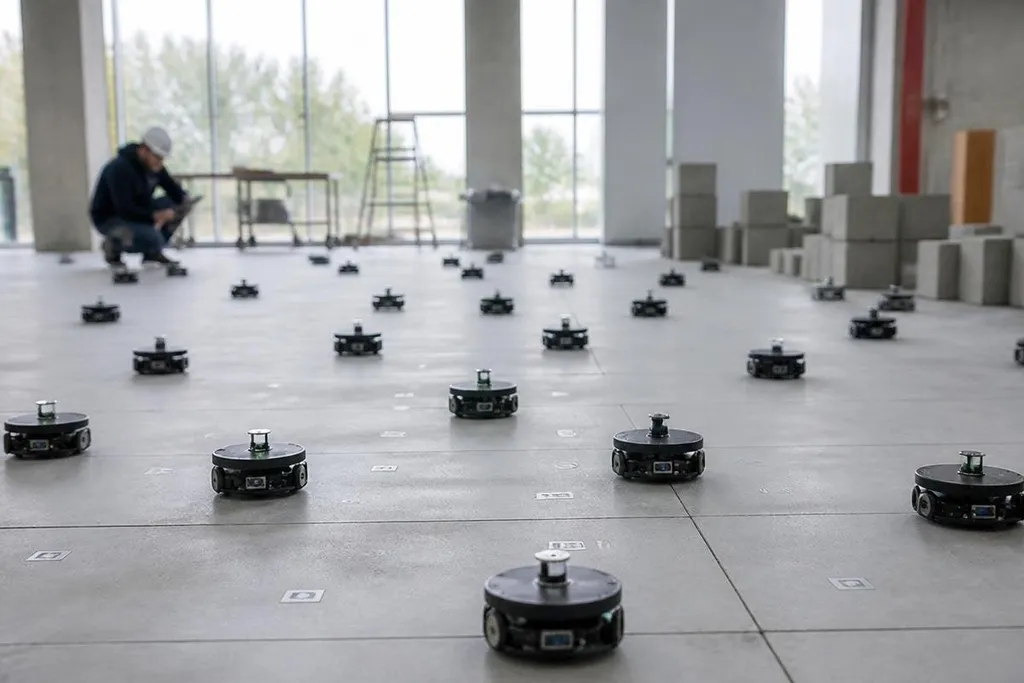
A group of small robots can do work that one large robot cannot, but only if each unit follows the same local rules. The useful idea is a swarm: many machines share a task without waiting for one computer to direct every move.
- Shared work split across many small units
- Local sensing instead of one control room
- Failure handled by replacing behavior, not repairing one large machine
How the group stays together
Each robot would need to sense nearby robots, obstacles, and signs that mark the work area. It could use short-range radio, infrared light, cameras, or LiDAR, which measures distance with laser pulses.
The robot would then make a small decision from that local view. It might move toward an open area, keep a set distance from another unit, or stop when its path is blocked. No robot needs a full map of the site to follow these rules.
This approach is called decentralized control. The word sounds heavy, but the idea is plain: each robot acts on nearby information, and the group’s behavior comes from those repeated choices.
A swarm could use consensus rules when the group needs one shared answer.
For example, robots might count nearby units before choosing a route, then change direction when enough of the group reports a blocked path. That avoids a single control computer becoming the only point of failure.
The work has to be split cleanly
A large group still needs a job plan. The system might divide a floor into areas, assign robots to collect sensor readings, or send units toward a location where more machines are needed.
The assignment method matters because small robots have limited battery capacity, radio range, and lifting force. A robot sent too far from its charging point may finish its part of the task and then stop before returning.
One useful pattern is repeated reassignment. When a unit drops out, nearby robots can take over its unfinished area. That only works when the system records which parts are complete, which are open, and which robot is handling each part.
The same rule can support search work. If one robot finds a marked object, it can send the location to nearby units. The group can then spread out instead of sending every robot to the same place.
Small failures become a design test
The system should expect some robots to stop working. Dust may block a sensor, a wheel may jam, or a battery may run low. The group needs a way to notice the missing unit and keep the task moving.
That does not mean the system can ignore safety. Robots moving near people need clear stop rules, limits on speed, and a way for a person to halt the group. A short radio message should not be the only safety control, because interference can interrupt it.
The group also needs protection from bad instructions. One damaged sensor could report a false obstacle and cause nearby robots to stop. One faulty radio could send repeated messages and slow the network.
I’d judge a swarm system by its recovery after one robot fails, not by a clean video of all units moving together.
That test needs more than a clean formation. For industry readers, Robot24.com robotics coverage can place swarm designs beside named companies, test sites, and the tasks those units must handle.
Where the idea fits
Tiny robots make more sense when the work area is wide, repetitive, or hard to reach with a large machine. They could map a damaged building, inspect a large storage space, or carry out repeated measurements across a field.
They fit less well when each job needs a strong arm, a heavy payload, or careful contact with a person. A group of small robots cannot avoid the limits of its motors and batteries by adding more units. It may also create more radio traffic, more maintenance work, and more chances for units to block one another.
The open question is not whether thousands of robots can move at once. It is whether they can share space, divide work, and recover from faults at a cost that makes sense.
A practical test for a swarm plan
Before buying or building a system, check these points:
- Name the task: State the exact work each robot must finish.
- Set the local rules: Define how a unit avoids people, walls, and other robots.
- Measure the link: Test radio range and message delays in the real work area.
- Plan lost units: Decide how the group detects a stopped robot and assigns its work again.
- Control battery use: Mark charging points and set a return level before the battery runs low.
- Stop the group: Give staff a physical stop method that works without the network.
A swarm becomes useful when its rules are easier to manage than one large machine. Until a system can show safe traffic, clear task records, and recovery after failure, thousands of tiny robots remain a design proposal rather than a working fleet.